

What Is GRP?
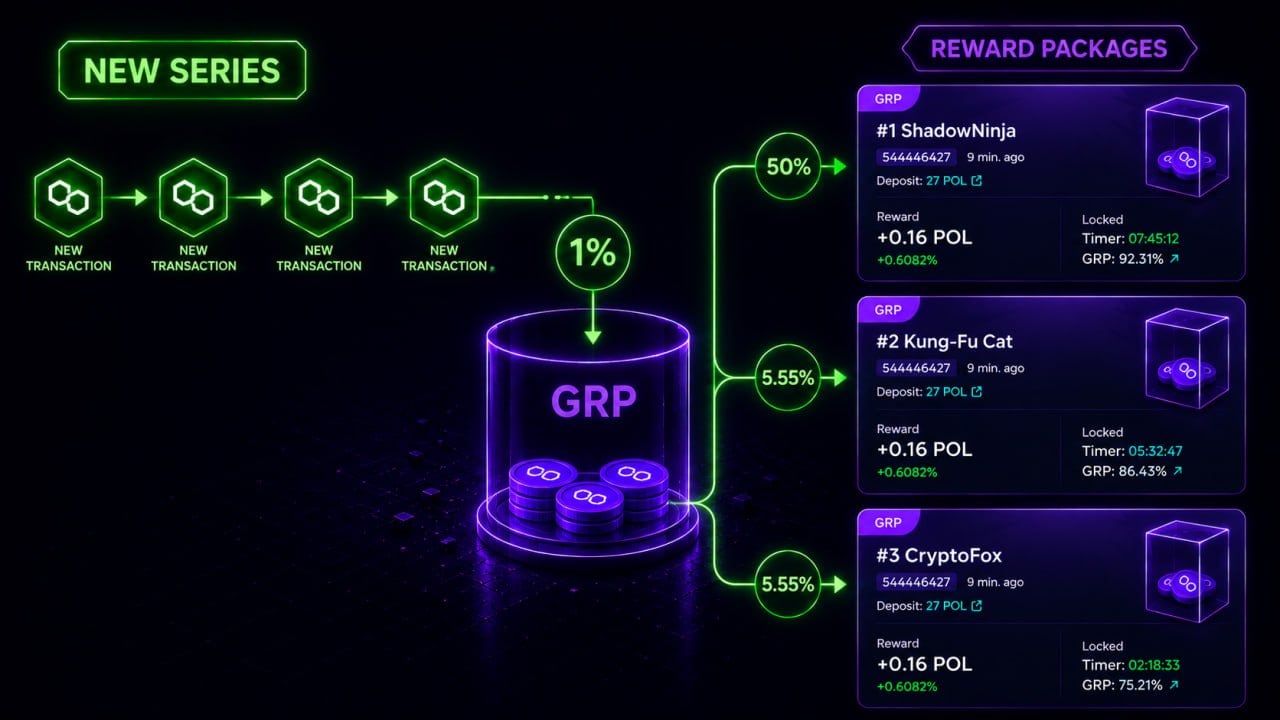
GRP is a mechanism designed to activate rewards for Reward Packages remaining from a completed series. All outstanding packages from the completed series are transferred to GRP and receive a new reward activation condition: instead of waiting for the next track to be completely filled, they must wait for the required liquidity to accumulate in GRP. The 8-hour minimum waiting period remains in effect. Within GRP, Reward Packages are arranged in a priority queue. Priority is calculated based on factors such as package creation date, reward amount, and other parameters. Every user can find their package in the list and check its position in the queue. When GRP is active, a percentage of the liquidity from the currently active series is directed to it. The liquidity allocated to GRP is distributed as follows:- 50% is allocated to the first Reward Package in the queue.
- 50% is distributed equally among the next 10 Reward Packages in the queue.
What Happens When Tracks Become Too Large?
The system automatically:- Closes the current series.
- Stops opening new tracks within that series.
- Launches a new series with the initial track capacities.
- Continues activating Reward Packages from the previous series through the GRP mechanism.
Why Was GRP Created?
Each successive track in MATIK is slightly larger than the previous one. This gradual increase is necessary to ensure that, as a new track fills up, enough liquidity becomes available to activate rewards for participants in the preceding track. However, the chain cannot grow indefinitely. Over time, track capacities become increasingly large. Filling each new track requires more liquidity, which can slow down the progress of the entire sequence. As a result, participants who join near the end of a series may have to wait a long time for the next track to fill and for their rewards to become available. GRP was created to address this problem.A Simple Example
Imagine that Series #1 consists of a growing sequence of tracks. Over time, the tracks become so large that filling them slows down significantly. At this point, the protocol closes Series #1 and launches Series #2, where the track sequence starts again with its initial capacities. With every transaction in Series #2, part of the liquidity is directed toward filling the new tracks, while another portion is allocated to GRP to activate rewards for participants whose packages remained in the final tracks of Series #1. As new liquidity enters the system, these packages are progressively funded and activated. With sufficient community activity, the required liquidity may accumulate within 8 hours. However, reward activation cannot occur before the minimum 8-hour period from package creation has elapsed. [Image — Keep the original series transition illustration]Solving the Problem for the Last Participants
In a traditional sequential model, participants in the final track face the greatest challenge. To receive their rewards, the next track must be completely filled. However, when a series ends, no additional tracks are created within it. Without GRP, participants in the final tracks could be left without a source of new liquidity to activate their rewards. GRP provides this source of liquidity through new transactions in the following series.GRP allows MATIK to close excessively large track sequences and launch new series while maintaining a mechanism for activating the outstanding rewards of previous participants. A portion of the liquidity generated by transactions in the new series is directed to GRP and used to fund and activate Reward Packages remaining from the previous series.